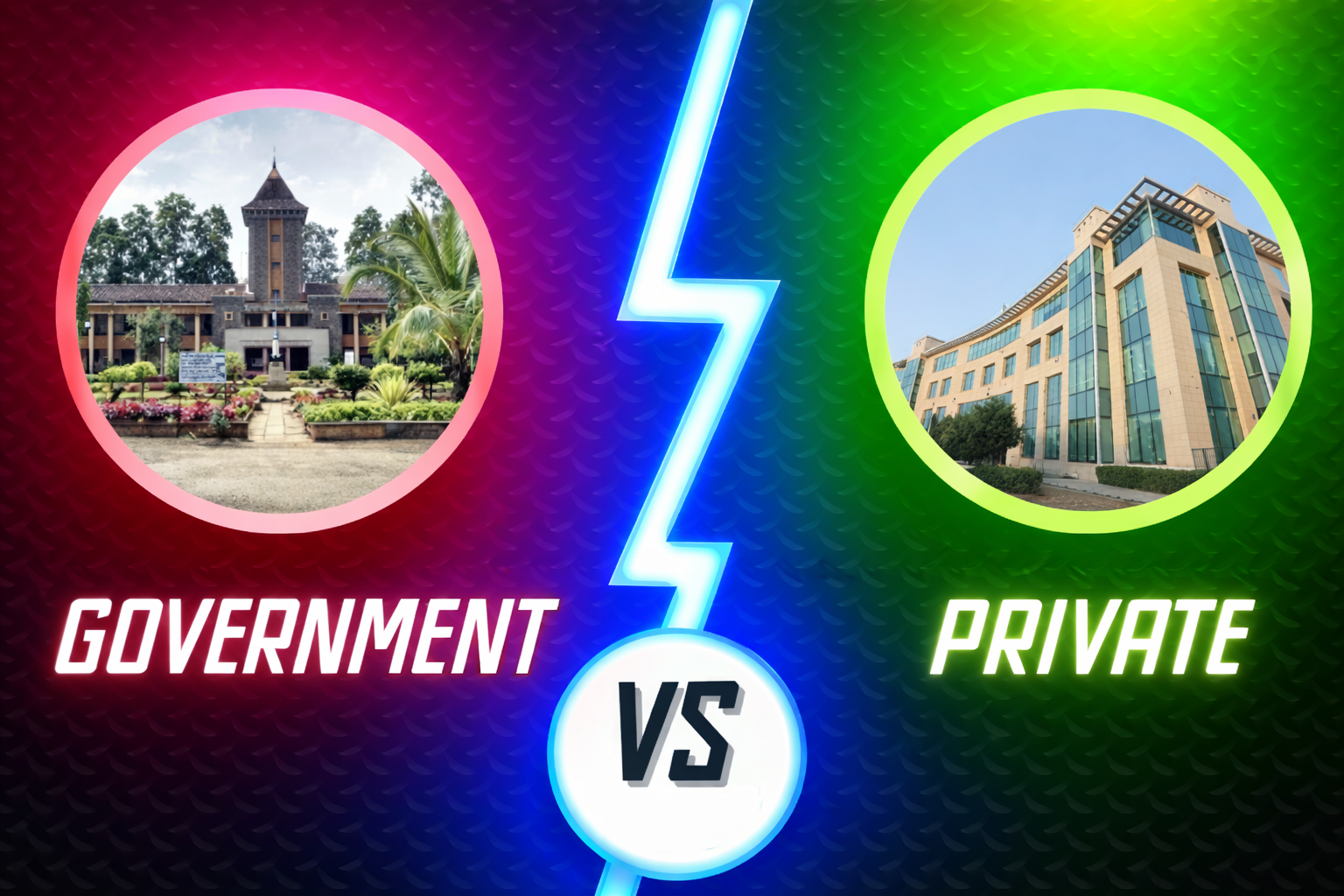
Understanding the Core Difference
Government Colleges
- Funded by central or state governments
- Lower tuition fees
- Entry through competitive exams
- Limited seats
Private Colleges
- Funded by private bodies or trusts
- Higher fees
- Easier admission in many cases
- Larger intake capacity
The difference is not just financial—it affects learning environment, pressure, and long-term outcomes.
Private vs Government Colleges
1. Fees and Affordability
- Government Colleges: ₹10,000–₹50,000 annually. Affordable for middle-class families.
- Private Colleges: ₹1–4 lakh annually. Heavy financial burden unless scholarships are available.
2. Admission Process
- Government Colleges: Highly competitive exams (JEE, NEET, CUET). Limited seats.
- Private Colleges: Easier admission through management quota, but merit-based seats also exist.
3. Infrastructure
- Government Colleges: Often outdated labs and classrooms, though IITs and NITs are exceptions.
- Private Colleges: Modern facilities, digital classrooms, industry tie-ups.
4. Faculty Quality
- Government Colleges: Experienced professors, but sometimes limited industry exposure.
- Private Colleges: Younger faculty, often with industry connections, but quality varies widely.
5. Placements
- Government Colleges: IITs, IIMs, AIIMS offer top placements. Average government colleges struggle.
- Private Colleges: Strong placement cells in reputed institutions (BITS, VIT, Manipal), but weaker ones have poor records.
6. Return on Investment (ROI)
- Government colleges provide high ROI due to low fees.
- Private colleges require strong placements to justify high costs.
📊 Comparison Table: Private vs Government Colleges
| Factor | Government Colleges (2026) | Private Colleges (2026) |
|---|---|---|
| Fees | ₹10,000–₹50,000 annually | ₹1–4 lakh annually |
| Admission | Competitive exams only | Exams + management quota |
| Infrastructure | Basic, exceptions IIT/NIT | Modern, industry tie-ups |
| Faculty | Experienced, academic focus | Industry exposure varies |
| Placements | Strong in top institutes | Good in reputed colleges |
| ROI | High | Moderate to low |
🔍 Key Insights
- Prestige vs Accessibility: Government colleges are prestigious but hard to enter. Private colleges are accessible but expensive.
- ROI matters: Government colleges win on ROI, private colleges win on infrastructure.
- Case studies prove mixed outcomes: Success depends on student effort, not just the institution.
🚀 Practical Tips for Students
- Check placement records before choosing a college.
- Calculate ROI: Compare fees with average salary packages.
- Consider scholarships in private colleges.
- Look beyond brand names: Even lesser-known government colleges can provide value.
- Match your career goals: Tech-focused students may benefit from private colleges with industry tie-ups.
📌 Extended Case Studies
Case Study A: IIT vs Private Tech College
- IIT graduate paid ₹50,000 annually, secured a ₹20 lakh package.
- Private college graduate paid ₹3 lakh annually, secured a ₹6 lakh package.
- ROI clearly favored the government college.
Case Study B: Medical Student
- Government medical college fees: ₹30,000 annually.
- Private medical college fees: ₹10–15 lakh annually.
- Both graduates became doctors, but ROI was far higher in government institutions.
Case Study C: Business Student
- Private MBA college in Pune charged ₹5 lakh annually. Placements averaged ₹7 lakh.
- IIM graduate paid ₹2 lakh annually, placements averaged ₹20 lakh.
📌 Future Trends
- Hybrid models: Private colleges collaborating with government schemes.
- Skill-based hiring: Employers focusing less on college brand, more on skills.
- Digital learning: Online platforms reducing dependence on traditional colleges.
Degree Value and Recognition
Government College Degrees
- High credibility
- Better acceptance in government jobs
Private College Degrees
- Recognition depends on accreditation
- Reputation varies widely
Insight
Institution ranking matters more than ownership.
Discipline and Academic Pressure
Government Colleges
- More independence
- Less monitoring
- Requires self-discipline
Private Colleges
- Strict attendance rules
- Regular assessments
- Structured environment
Case Study
A student needing discipline thrived in a private college, while a self-driven student succeeded in a government college.
Government Jobs and Competitive Exams
Government College Advantage
- Better preparation environment
- Flexible schedules
Private College Challenge
- Attendance restrictions
- Limited time
Case Study
A student preparing for civil services found government college schedules more flexible.
Return on Investment (ROI)
Government Colleges
- High ROI due to low fees
- Even moderate salary offers bring value
Private Colleges
- ROI depends on placement success
- High fees increase break-even time
Case Study
A government college graduate repaid education costs within a year, while a private college graduate took longer due to loans.
Is It Harder to Get Into Government Colleges Compared to Private Ones?
Choosing between government and private colleges is one of the biggest decisions for students in India. A common doubt is whether getting admission into government colleges is harder than private ones. The reality is that government colleges are more competitive due to limited seats, lower fees, and higher prestige.
📌 Admission Process in Government Colleges
Government colleges usually admit students through national or state-level entrance exams such as JEE, NEET, or CUET. These exams are highly competitive, with lakhs of students competing for a few thousand seats. For example, in 2025, over 12 lakh students appeared for JEE Main, but only a fraction secured seats in IITs and NITs. This makes entry into government institutions significantly tougher.
📌 Admission Process in Private Colleges
Private colleges, on the other hand, offer multiple admission routes. While many conduct entrance exams, they also admit students through management quota or direct admission. This makes it easier for students who may not score high in competitive exams to still secure a seat, provided they can afford the higher fees.
📌 Why Government Colleges Are Harder to Enter
- Limited Seats: Fewer seats compared to the large number of applicants.
- Lower Fees: Affordable tuition attracts more students.
- Prestige: Institutions like IITs, IIMs, and AIIMS are globally recognized.
- High ROI: Graduates often secure better placements with lower investment.
📌 Case Study
A student from Kanpur prepared for NEET and scored well but missed admission to a government medical college by a small margin. She later joined a private medical college, paying ₹12 lakh annually. This example shows how even capable students struggle due to intense competition in government institutions.
✅ Conclusion
Yes, it is harder to get into government colleges compared to private ones. The competitive exams, limited seats, and affordability make them highly sought after. Private colleges provide easier access but at a higher financial cost. Ultimately, success depends not just on the type of college but on the student’s effort, skill development, and career planning.