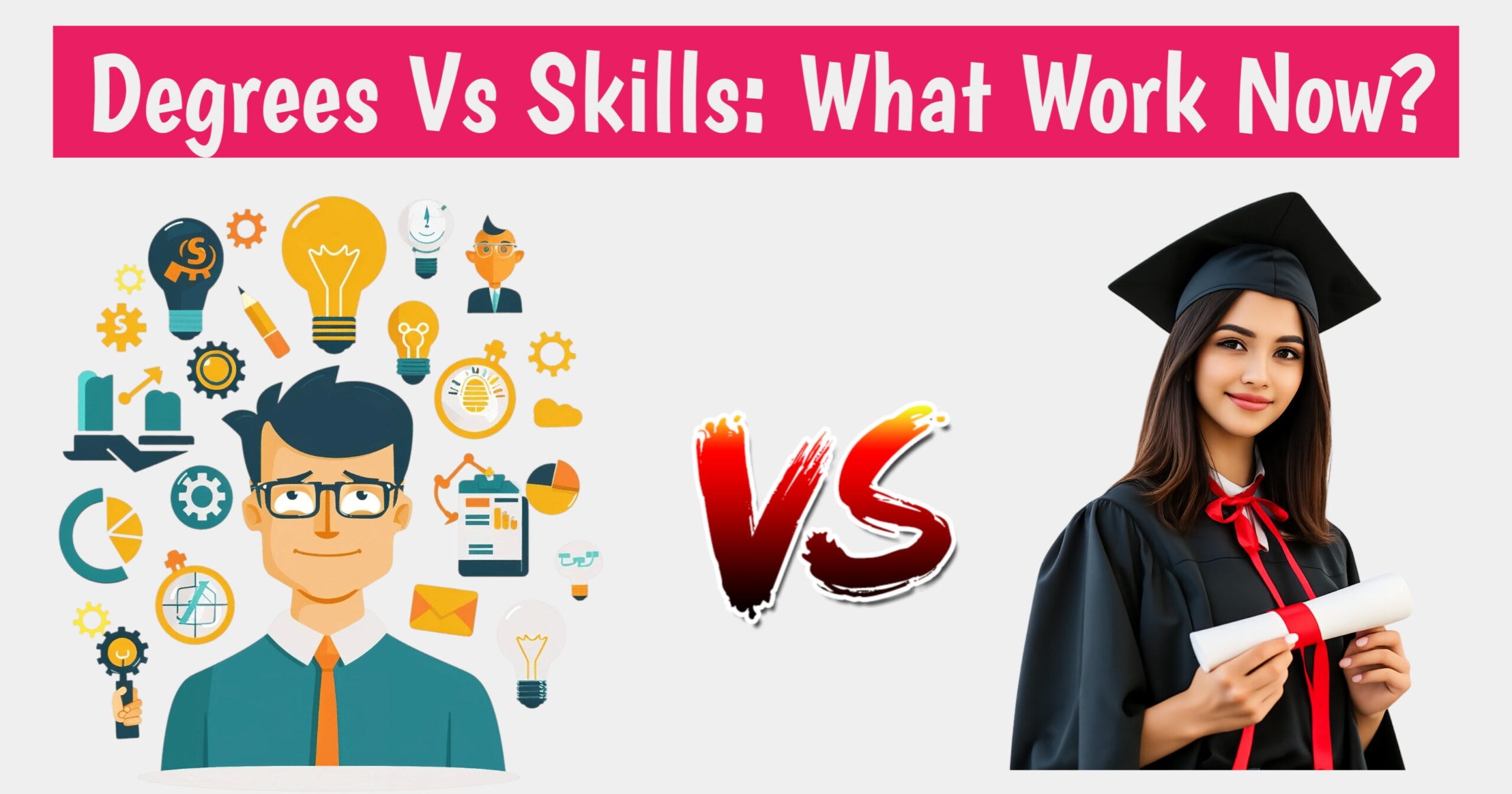
Understanding the Difference Between Degrees and Skills
What a Degree Represents
A degree is formal education from a recognized institution. It provides:
- Structured learning
- Theoretical foundation
- Certification of academic completion
Degrees often act as filters during hiring, especially in traditional industries.
What Skills Represent
Skills are practical abilities that can be applied directly to work. These include:
- Technical skills (coding, data analysis, design)
- Soft skills (communication, problem-solving, teamwork)
Skills show what a person can actually do.
1. Degrees Provide Foundation, Skills Provide Application
- Degrees: Offer structured knowledge, credibility, and career pathways in regulated fields like medicine, law, and engineering.
- Skills: Provide hands-on ability to solve problems, adapt to technology, and deliver results.
Example: A computer science degree teaches algorithms, but coding skills in Python, Java, or AI frameworks make a graduate employable.
2. Employers Value Skills More Than Titles
- Data: A 2025 PwC report found that 65% of companies hire based on skill assessments rather than degrees alone.
- Case Study: A student in Hyderabad without a formal MBA but with digital marketing certifications secured a role in a multinational company.
3. Degrees Still Matter in Certain Fields
- Medicine, law, chartered accountancy, and civil services require formal degrees.
- Skills alone cannot replace regulated qualifications.
Example: A doctor must hold an MBBS degree, but communication and empathy skills determine patient satisfaction.
4. Skills Drive Career Growth
- Data: World Economic Forum (2025) reported that 50% of skills required in jobs change every 3–4 years.
- Case Study: A mechanical engineer in Chennai learned renewable energy design skills and transitioned into the EV industry, doubling his salary.
5. Hybrid Approach Works Best
- Degrees provide credibility.
- Skills provide adaptability.
- Together, they create employability.
Example: A student in Lucknow completed a B.Com degree but also learned financial modeling. She secured a role in investment banking, outperforming peers with only degrees.
📊 Comparison Table: Degrees vs Skills
| Factor | Degrees (2026) | Skills (2026) |
|---|---|---|
| Cost | High (₹3–10 lakh) | Low (₹20,000–₹1 lakh for courses) |
| Time Required | 3–5 years | 3–12 months |
| Industry Value | High in regulated fields | High in tech, business, creative |
| Flexibility | Limited | Very flexible |
| Employability | 48% (India Skills Report 2025) | 72% (LinkedIn survey 2025) |
| Career Growth | Slower without skills | Faster with continuous learning |
🔍 Key Insights
- Degrees are necessary but not sufficient.
- Skills are dynamic and future-proof.
- Employers prefer candidates who combine both.
Skills That Work Across All Degrees
Some skills improve career outcomes regardless of degree.
- Communication
- Digital literacy
- Critical thinking
- Time management
- Basic data handling
Case Example
A humanities graduate with strong communication skills excelled in corporate training roles.
The Role of Online Learning
Online platforms have changed skill access.
Benefits:
- Affordable learning
- Industry-relevant content
- Self-paced progress
Reality
Online learning complements formal education, not replaces it.
How Students Should Decide: Degree, Skills, or Both?
Step-by-Step Approach
- Choose a degree aligned with interests
- Identify industry-relevant skills
- Practice skills through projects
- Apply learning through internships
Case Study
A B.Tech student learned cloud tools independently and secured a placement due to skill alignment.
Parental and Social Pressure
Families often prefer degrees due to:
- Social acceptance
- Perceived stability
Solution
Open discussions and awareness of market realities help balance expectations.
Degree vs Skills in Government and Private Sector
Government Sector
- Degree mandatory
- Skills help with performance
Private Sector
- Degree preferred
- Skills essential
Can Skills Alone Get Me a Job Without a Formal Degree?
In 2026, one of the most common questions students and professionals ask is whether skills alone can secure a job without a formal degree. The short answer is yes, but with important conditions.
📌 Skills Are Becoming the New Currency
Employers today value practical ability over academic certificates. A LinkedIn survey in 2025 revealed that 72% of recruiters prioritize skills and experience over degrees. Industries like technology, digital marketing, design, and data analytics often hire candidates based on portfolios, certifications, and proven expertise rather than traditional qualifications.
📌 Case Studies
- Tech Industry: A student in Bengaluru skipped a formal computer science degree and instead completed coding bootcamps. Within six months, he landed a job as a junior developer at a startup, earning ₹8 lakh annually.
- Digital Marketing: A commerce graduate in Delhi struggled to find work with her degree alone. After learning SEO and social media marketing, she secured freelance projects worth ₹40,000 per month.
- Creative Fields: Graphic designers, video editors, and content creators often build careers through online portfolios and freelancing platforms, proving that skills can outweigh degrees.
📌 Limitations
However, skills alone cannot replace degrees in regulated professions like medicine, law, or chartered accountancy, where formal education is mandatory. In these fields, skills complement but cannot substitute degrees.
✅ Conclusion
Yes, skills alone can get you a job, especially in tech, creative, and digital industries. But success depends on building a strong portfolio, gaining certifications, and continuously updating your abilities. For regulated fields, degrees remain essential, but for most modern careers, skills are the real key to employability in 2026.
Why Are So Many Graduates Unemployed Despite Having Degrees?
In 2026, one of the biggest challenges facing young professionals is unemployment despite holding degrees. This issue is widespread across India and globally, and the reasons are more practical than academic.
📌 Skill Gap
A major reason is the mismatch between university education and industry needs. Degrees often focus on theory, while employers demand practical skills such as coding, data analysis, communication, and problem-solving. According to the India Skills Report 2025, only 48% of graduates were considered employable based on industry skill assessments.
📌 Lack of Experience
Employers prefer candidates with internships, projects, or real-world exposure. Many graduates complete their degrees without hands-on training, making it difficult to compete with peers who have practical experience.
📌 Changing Industry Demands
Technology and automation are reshaping jobs. Skills required today are different from those taught in traditional curricula. The World Economic Forum (2025) reported that 50% of skills needed in jobs change every 3–4 years, leaving many graduates outdated.
📌 Case Study
A mechanical engineering graduate in Pune applied to multiple companies but was rejected because he lacked knowledge of CAD and renewable energy systems. Meanwhile, another student who completed short-term skill courses in design software secured a job within months.
📌 Conclusion
Graduates are unemployed not because degrees are useless, but because degrees alone are insufficient. Employers now expect a combination of academic knowledge and practical skills. To improve employability, students must focus on internships, certifications, and continuous skill development alongside their degrees.
Final Word: In 2026, the real key to employment is not just holding a degree—it’s proving you can apply knowledge through relevant skills.